
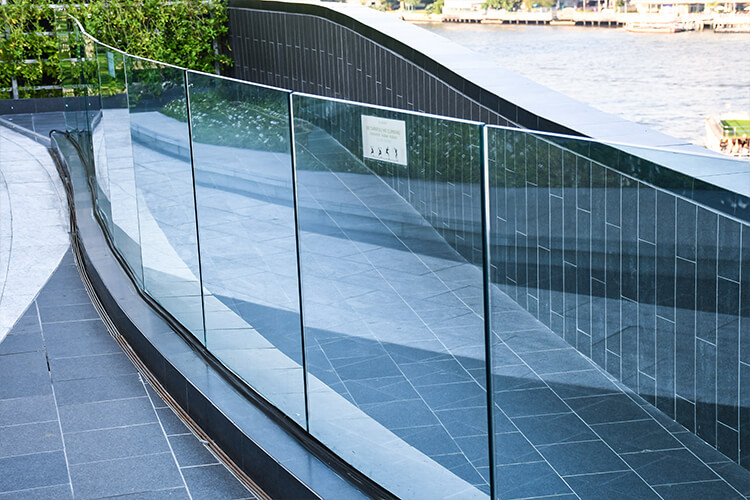
What is Toughened Glass?
Toughened glass, also known as tempered glass, is a type of safety glass strengthened through controlled heat treatment. It is made by heating annealed glass to a high temperature and then rapidly cooling it, making it approximately 4–5 times stronger than annealed glass of the same thickness. If it breaks, it shatters into small, blunt fragments, significantly reducing the risk of injury.
It is highly durable, impact-resistant, and able to withstand thermal stress, making it suitable for applications such as –
- Windows and doors – Shower doors, glass railings, and other safety-critical areas.
- Tabletops and shelves – Helps reduce injury risk in case of breakage.
- Building facades – Large commercial glass panels requiring structural integrity.
- Automobiles – Side and rear windows to reduce injuries during accidents.
Important – Once tempered, toughened glass cannot be cut or altered without losing its strength. Any shaping or customization must be done before the tempering process. Toughened glass and conventional glass differ significantly in their properties, as outlined below –
Tempered Glass Breakage Behavior
One of the most important safety features of toughened glass is its breakage behavior. When it breaks, it shatters into small, blunt fragments, reducing the risk of injury to users. These fragments are much less likely to cause severe cuts compared to the large, sharp shards produced by conventional glass. Conventional glass can form dangerous, jagged pieces that pose a higher risk of injury, making it less suitable for applications where human safety is a concern.
Manufacturing of Tempered Glass
Toughened glass undergoes a special thermal or chemical tempering process. It is heated to high temperatures and then rapidly cooled to create internal stress patterns that increase its strength. Conventional glass, on the other hand, is made by slowly cooling molten glass at a controlled rate to relieve internal stress. This simpler process results in glass that is less strong and more prone to breaking into sharp pieces.
How is Toughened Glass Made?
There are mainly two methods for producing toughened glass: thermal tempering and chemical toughening.
Thermal Tempering: This is the most common method. Ordinary glass is heated to approximately 620°C and then rapidly cooled using jets of cold air. This abrupt cooling puts the outer surfaces of the glass into compression while the interior remains in tension. The difference in stress strengthens the glass, making it approximately 4–5 times stronger than annealed glass of the same thickness. The higher the thermal expansion and the lower the thermal conductivity of the glass, the greater the residual stress, resulting in more durable glass.
Chemical Toughening: In this method, the glass is immersed in a molten potassium salt bath. Smaller sodium ions in the glass are replaced by larger potassium ions from the bath, creating a layer of compressive stress on the surface. This chemical process strengthens the glass without heating it, making it suitable for applications where high heat might cause distortion.
Both methods result in stronger, safer, and more durable glass suitable for a wide range of architectural, automotive, and consumer applications.
Types of Toughened Glass
Toughened glass is available in several types of tempered glass, each suited for specific applications and aesthetic needs. The main types include –
- Clear Toughened Glass – Standard transparent glass that offers strength and safety while maintaining clarity.
- Laminated Toughened Glass – Combines layers of toughened glass with interlayers for extra safety and sound insulation.
- Reflective Toughened Glass – Coated to reduce glare and heat, often used in building facades.
- Tinted Toughened Glass – Colored glass that reduces sunlight transmission and enhances privacy.
- Frosted Toughened Glass – Opaque or semi-opaque glass that provides privacy while still allowing light to pass through.
Toughened Glass Benefits
Tempered glass offers several key tempered glass benefits over ordinary glass –
- Exceptional Strength – Toughened glass is approximately 4–5 times stronger than standard annealed glass of the same thickness, while maintaining the same transparency and light transmission.
- Thermal Resistance – It can withstand temperature variations of up to 250°C, compared to just 40°C for normal glass.
- Safety – If it does break, it shatters into small, blunt fragments that are unlikely to cause serious injuries.
- Shock Resistance – Highly resistant to both electric and thermal shocks.
- Durability – Its long-lasting strength reduces the need for frequent replacement, making it ideal for both residential and commercial applications.
Applications of Toughened Glass
Toughened glass is widely used due to its strength, durability, and safety features. Key tempered glass applications include –
- Architectural Use – Ideal for skyscrapers, high-rise buildings, standalone glass walls, and large windows, as it can withstand extreme conditions without shattering into dangerous pieces.
- Bathrooms and Wet Areas – Heat-tempered glass is resistant to moisture and temperature changes, making it perfect for shower doors and partitions.
- Furniture and Interiors – Used for tabletops, shelves, frameless doors, and glass dividers due to its strength and scratch resistance.
- Kitchenware and Lab Equipment – Can be molded into cookware, oven doors, lab glassware, and other heat-resistant applications.
- Security Applications – Laminated toughened glass is combined with other materials to create bulletproof and impact-resistant glass for vehicles and buildings.
- Electronics – Toughened glass is used in phone screens and other devices for durability and scratch resistance.
To learn more about the practical uses and technical properties of toughened glass, you can also read this detailed guide on toughened glass uses and properties. Its high durability ensures long-lasting performance, maintaining clarity and smoothness even under daily wear and tear.
Low Maintenance of Toughened Safety Glass
Toughened safety glass is highly durable and requires minimal maintenance due to its unique properties –
- Breakage Resistance – Its strength makes it less prone to breaking from external pressures or accidental impacts, reducing the need for replacements or repairs.
- Scratch Resistance – The tempering process enhances scratch resistance, helping maintain clarity and appearance over time.
- Heat and Thermal Stress Resistance – It tolerates higher temperatures than conventional glass, minimizing damage from thermal stress and reducing replacement frequency.
- Easy to Clean – Smooth, non-porous surfaces make cleaning simple – usually just a damp cloth or mild cleaning solution is enough.
- Long-Lasting Durability – Toughened glass retains its integrity and appearance over many years, lowering maintenance and replacement needs.
Regular cleaning and inspections ensure that toughened glass continues to provide optimal safety, durability, and aesthetic benefits.
For world-class branded glass products, including automotive, consumer, and commercial solutions, AIS Glass, known for offering the best tempered glass in India, provides a wide range of toughened glass options to enhance the safety, energy efficiency, and style of your spaces.